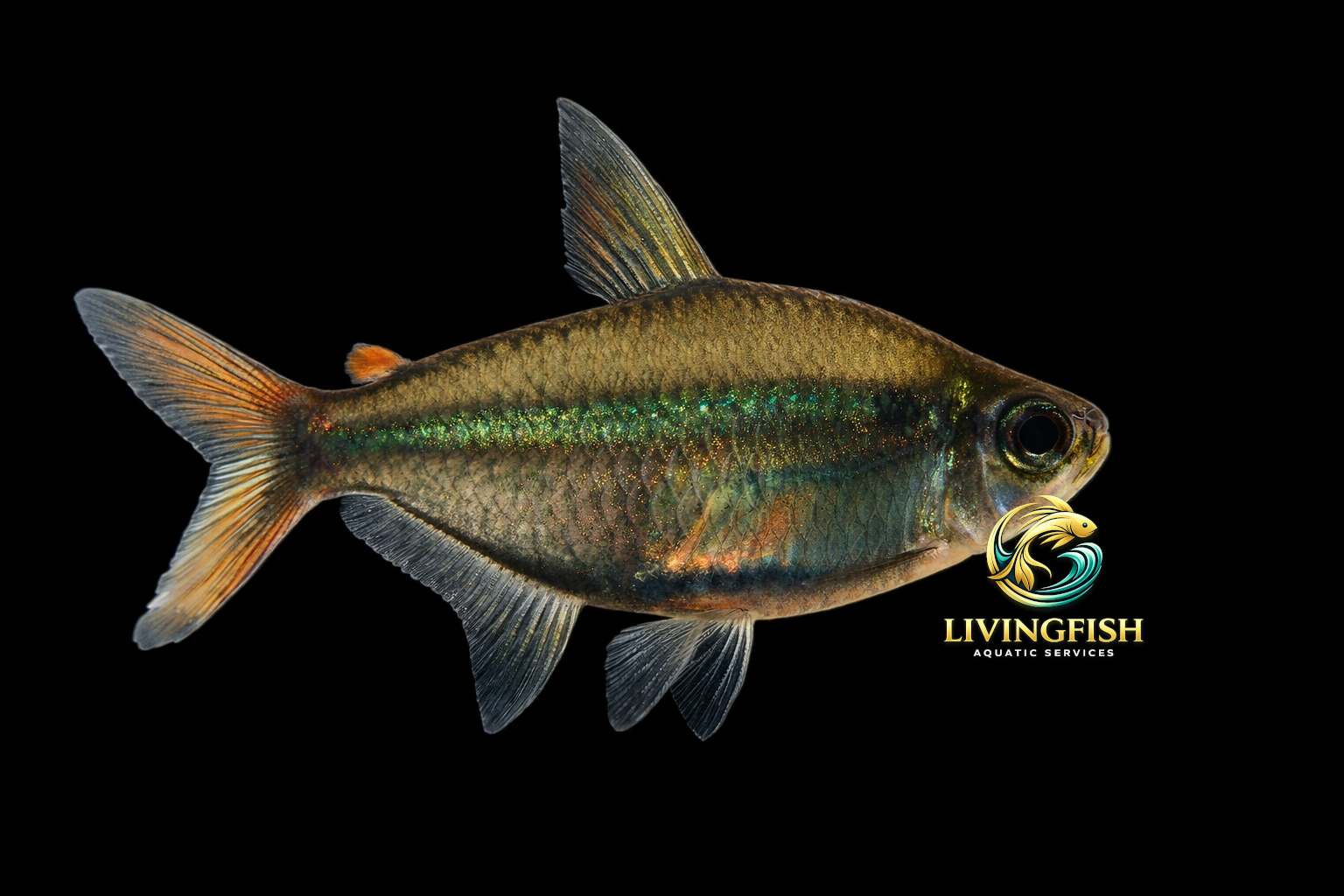

In the quiet light of a forest stream, where leaf shadows drift across the water and the current moves with unhurried purpose, small silver forms gather in the open spaces between roots and fallen branches. Among them, Moenkhausia collettii glimmers like a loose thread of sunlight, each fish catching the glow for a moment before slipping back into the soft green of the water. It is a species that rewards patience. Watch long enough and you begin to see the rhythm of its world, steady and unforced, shaped by the gentle pulse of South American waters.
Species Information
Moenkhausia collettii, often known as Collett’s Tetra, is a small characin native to the slow to moderate streams of the Amazon basin, where soft, warm water flows over leaf litter and fine sediments. Adults reach around five centimetres and thrive at temperatures between twenty four and twenty eight degrees in clean, slightly acidic to neutral water. Their behaviour is peaceful and quietly social, with a preference for the company of their own kind and a calm, open swimming style that reflects the gentle habitats from which they come.
Behaviour and Temperament
There is a softness to the way Moenkhausia collettii moves. In the wild it forms loose shoals that drift through midwater, breaking apart and reforming with an easy confidence. Individuals feed by picking at tiny invertebrates and organic particles carried by the current, rising and falling in small arcs as they search. In the aquarium this behaviour remains much the same. They are steady swimmers that rarely rush, choosing instead to explore the water column with quiet purpose. When kept in a group they show a subtle social language, turning together when startled, relaxing again as soon as the moment passes. Their colours brighten when they feel secure, and a settled group often displays a gentle shimmer that seems to pulse with the light.
Habitat and Care
To keep this species well, it helps to think of the shaded forest streams it calls home. A soft substrate of sand or fine gravel suits them, with scattered leaves or botanicals to lend a natural tint to the water. Plants can be used freely, though they appreciate open swimming space as much as cover. Gentle flow is ideal, enough to keep the water fresh without pushing them from their chosen paths. Lighting should be calm rather than intense, allowing their reflective scales to glow without glare. Water chemistry leans toward the softer side, though they adapt well if changes are made slowly. Peaceful tank mates such as small tetras, Corydoras, and dwarf cichlids complement their temperament. Above all, they respond to stability, clean water, and the comfort of a well kept shoal.
Breeding
Breeding Moenkhausia collettii follows the quiet patterns of many small characins. Courtship begins with gentle circling and brief chases, the male showing slightly brighter tones as he guides the female toward fine plants or spawning mops. Eggs are scattered rather than placed, falling among leaves or into the shelter of dense growth. There is no parental care, so adults are best removed once spawning is complete. The eggs hatch within a couple of days, and the fry rise to free swimming soon after, feeding first on infusoria and later on newly hatched Artemia. Soft water, steady warmth, and subdued light encourage both spawning and fry development, mirroring the calm conditions of their natural breeding sites.
Moenkhausia collettii is not a fish that demands attention. Instead, it invites the aquarist to slow down and notice the finer details of movement and light. In a well kept aquarium it becomes a quiet presence that enriches the scene, a reminder of the gentle beauty found in the shaded waters of the Amazon. It is a species that rewards those who appreciate subtlety, offering a calm, enduring charm that stays with you long after the tank lights dim.