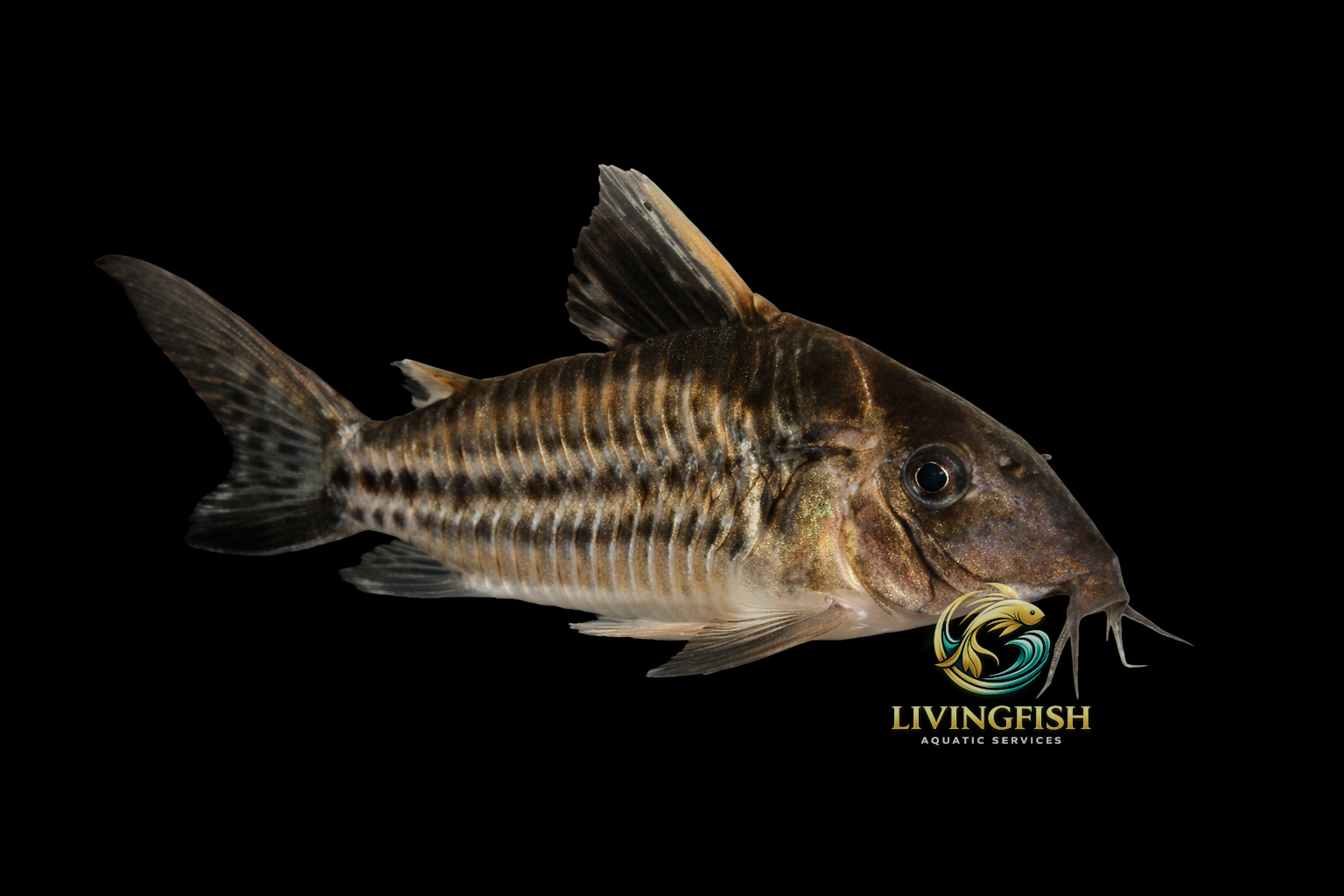

Brochis robusta: A Modern Overview of a Reclassified Amazonian Armoured Catfish
Brochis robusta is a large, heavily armoured catfish native to the central Amazon basin. The species was originally described in 1980 by Han Nijssen and Isaäc Isbrücker under the genus Corydoras. In 2024, a taxonomic revision based on morphological and genetic evidence reinstated Brochis as a separate genus. As a result, the species is now recognised as Brochis robusta, aligning it with other deep‑bodied, large‑finned members of the group.
Taxonomic Position
Brochis robusta belongs to the family Callichthyidae and sits within the subfamily Corydoradinae. The genus Brochis is characterised by a deeper body profile, a proportionally larger dorsal fin, and a more robust cranial structure compared with typical Corydoras species. These traits justify its placement within the revalidated genus.
Morphology and Diagnostic Features
This species is notable for its size, reaching around eight centimetres in standard length. The body is light brown with dense dark spotting that becomes more concentrated toward the dorsal region. A dark stripe crosses the eye, and the dorsal fin is predominantly black with a pale leading ray. The dorsal fin itself is larger and more triangular than that of most Corydoradinae, which is consistent with the genus.
The bony plates along the flanks form two protective rows, giving the fish a strongly armoured appearance. The head is broad and slightly sloped, and the barbels are well developed for substrate foraging. Males tend to have a more elongated dorsal fin ray and a slimmer body shape.
Distribution and Habitat
Brochis robusta is native to the Purus River basin in central Amazonia. It inhabits small tributaries such as the Rio Ipixuna, where the water is soft, warm, and often stained with tannins from decaying vegetation. These environments are typically shallow and slow moving, with sandy or fine sediment substrates.
The species is demersal and spends most of its time close to the substrate. Like other members of the subfamily, it is capable of air breathing through the intestine, a behaviour that allows survival in oxygen‑poor waters.
Behaviour and Ecology
This species is peaceful and social, forming groups in the wild. Grouping behaviour encourages natural foraging and reduces stress. The fish feed on small invertebrates and organic particles found within the substrate. Their constant probing and sifting behaviour is a defining ecological trait.
Eye movement is a characteristic behaviour of the group. The eye rotates downward in a flicking motion, which is believed to help with environmental scanning.
Reproduction and Life History
Although species‑specific reproductive studies are limited, Brochis robusta is expected to follow the typical reproductive pattern of Corydoradinae. Courtship involves close contact between the sexes, followed by the female depositing adhesive eggs on hard surfaces. Females are broader when viewed from above, especially when carrying eggs.
Conservation and Scientific Importance
The species is currently considered to be of low conservation concern. Its distribution within the Purus basin appears stable, and no major threats have been identified. The reclassification of the species into Brochis has increased its scientific relevance, as it helps clarify evolutionary relationships within the Corydoradinae and highlights the morphological diversity of Amazonian armoured catfish.
Summary
Brochis robusta is a large, strongly patterned armoured catfish that represents one of the more substantial members of its group. Since its original description in 1980 and its reclassification in 2024, it has gained renewed interest among ichthyologists and aquarists. Its size, distinctive morphology, and ecological behaviour make it an important species for understanding the diversity and evolution of South American catfish.